Blog Trustworthy AI 3 min read
A sequentially fair mechanism for multiple sensitive attributes
Most bias-correction methods handle one sensitive variable at a time. Real problems have several. It turns out the order you correct them in does not change where you end up, and that fact is more useful than it sounds.
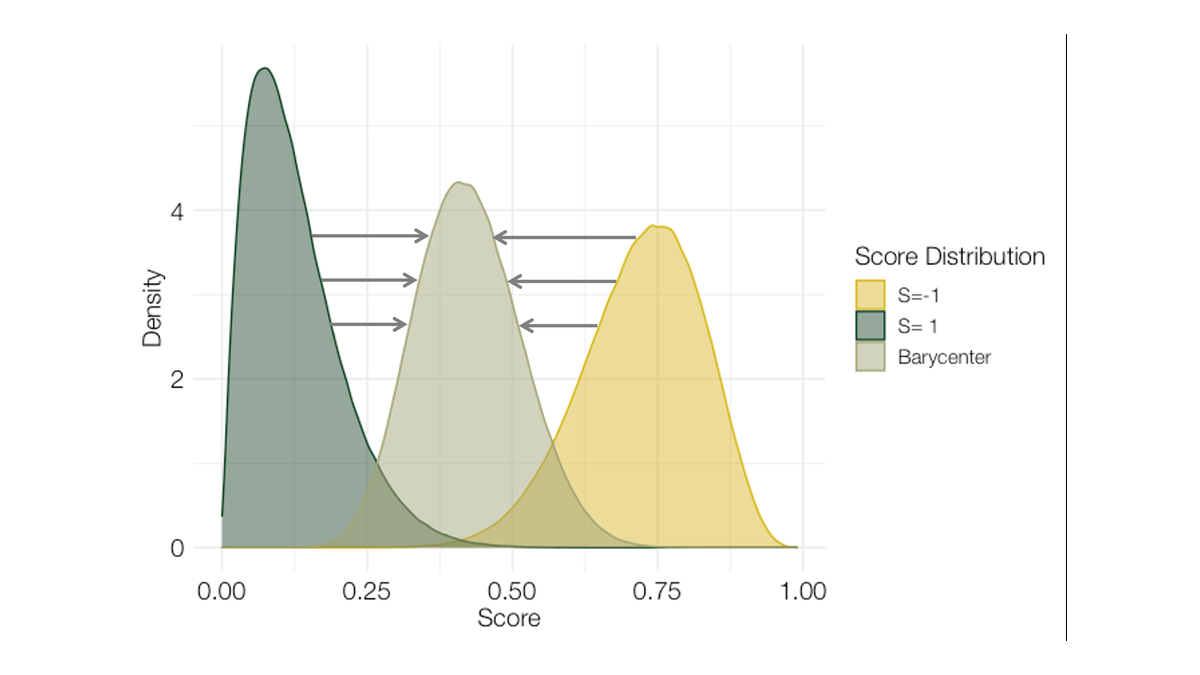
Fairness is rarely about one variable. A model touches age, sex, origin, location and a dozen proxies for all of them at once, and yet most bias-correction techniques are built to handle a single sensitive variable in isolation. That leaves practitioners with an awkward question: which bias do you correct first, and what does that choice do to everyone else?
This is the question behind our AAAI 2024 paper with Arthur Charpentier. The short version of the answer: correcting for one sensitive variable and then the other gives the same outcome as doing it the other way round. Because the destination does not depend on the route, you can study the route itself, and see who is affected at each step when you cannot correct everything at once.
Why excluding the variable is not enough
Algorithms reproduce the biases in their training data even when the sensitive variables have been removed, because they learn proxies for them. Postcode stands in for origin, occupation for sex, purchase history for almost anything. The goal is therefore not to hide the attribute but to make the model’s predictive distribution indistinguishable across its values.
Fairness gerrymandering
There is a temptation to pick the sensitive features that make a model look best and to evaluate only those. Correcting for sex alone can produce a model that is defensible on sex and quietly worse on the intersection of sex and origin. Evaluating all the variables together, rather than one convenient one, is what stops the exercise from becoming presentational.
The obvious alternative is to treat the combination of all sensitive attributes as a single variable. That is clean in theory and difficult in practice: with a handful of attributes you get a large number of subgroups, most of them nearly empty, and estimates that are mostly noise.
The mechanism
Our approach removes the biases sequentially, transporting the score distributions towards a multi-marginal Wasserstein barycenter at each step. Two things fall out of it.
The final result does not depend on the order of correction. That is what makes the sequential view legitimate rather than arbitrary.
And because each step works with the marginal distributions rather than the full cross-product of subgroups, estimation does not depend on tiny cells. Adding a new sensitive attribute later is cheap, which matters when the list of protected characteristics is set by a regulator rather than by you.
What it looks like on real data
On US Census wage data, correcting for racial disparities improves outcomes for minority women and can make them worse for majority women. That is not an argument against correcting. It is the kind of trade-off that is usually invisible and is better stated out loud. With the effect of each step quantified, deciding which sensitive variables to prioritise becomes an explicit, arguable decision rather than an implicit one.
What this does not settle
The method does not answer what fairness ought to mean. It makes the consequences of a particular definition measurable, so the discussion can be about evidence rather than intuition. There is also a real cost: fairness and accuracy trade against each other, and the size of that trade is something to measure rather than assume.
The algorithms are implemented in EquiPy, so none of this requires reimplementing the paper.
Further reading. The paper (AAAI 2024, with Philipp Ratz and Arthur Charpentier), and the research summary Philipp and I wrote for the Montreal AI Ethics Institute, which this post follows closely.