Blog Dev 6 min read
Why Python?
Where Python sits among programming languages, why it took over scientific computing, and what it costs you in return.
Every course that starts with a language owes you a justification for the choice. This is mine. It is not that Python is the best language, because no language is. It is that Python is, today, the shortest path between a statistical idea and a result somebody else can reproduce.
This began as the opening notes of my Python course at EPITA in 2021. The argument has held up; the numbers in it had not, so they are current as of August 2026.
1. What Python is
Python is a high-level, interpreted, dynamically typed language created by Guido van Rossum and first released in
- High-level means the language hides the machine from you: no memory allocation, no pointers, no compilation step to think about. That is the whole trade, and everything below follows from it.
Two words worth pinning down now, because the rest of this post leans on them:
- Interpreted. Your code is executed statement by statement by another program (the interpreter), rather than translated ahead of time into machine code. You get instant feedback and one error at a time; you pay in speed.
- Dynamically typed. A variable has no declared type.
x = 3thenx = "three"is legal, and the type is only known while the code runs. You write less; the compiler catches less.
2. Where it stands today
Python has been number one in the TIOBE index since October 2021, and its lead has since become embarrassing: 18.5% in August 2026, against roughly 11% for C and 8% for C++. Historically only C and Java had ever led that index.
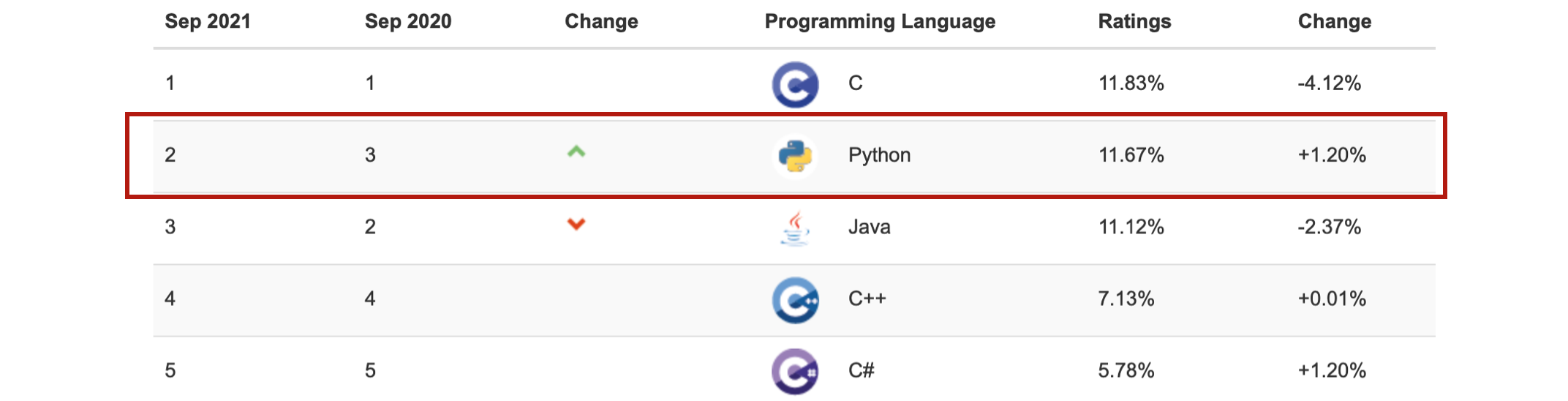 TIOBE top languages. The index is built from search-engine volume, so read it
as attention, not as lines of code in production.
TIOBE top languages. The index is built from search-engine volume, so read it
as attention, not as lines of code in production.
PYPL, which counts how often language tutorials are searched on Google, puts Python first by a wider margin still, which is unsurprising for a language that absorbs a constant stream of newcomers.
 PYPL: tutorial searches on Google.
3. Twenty years of drift
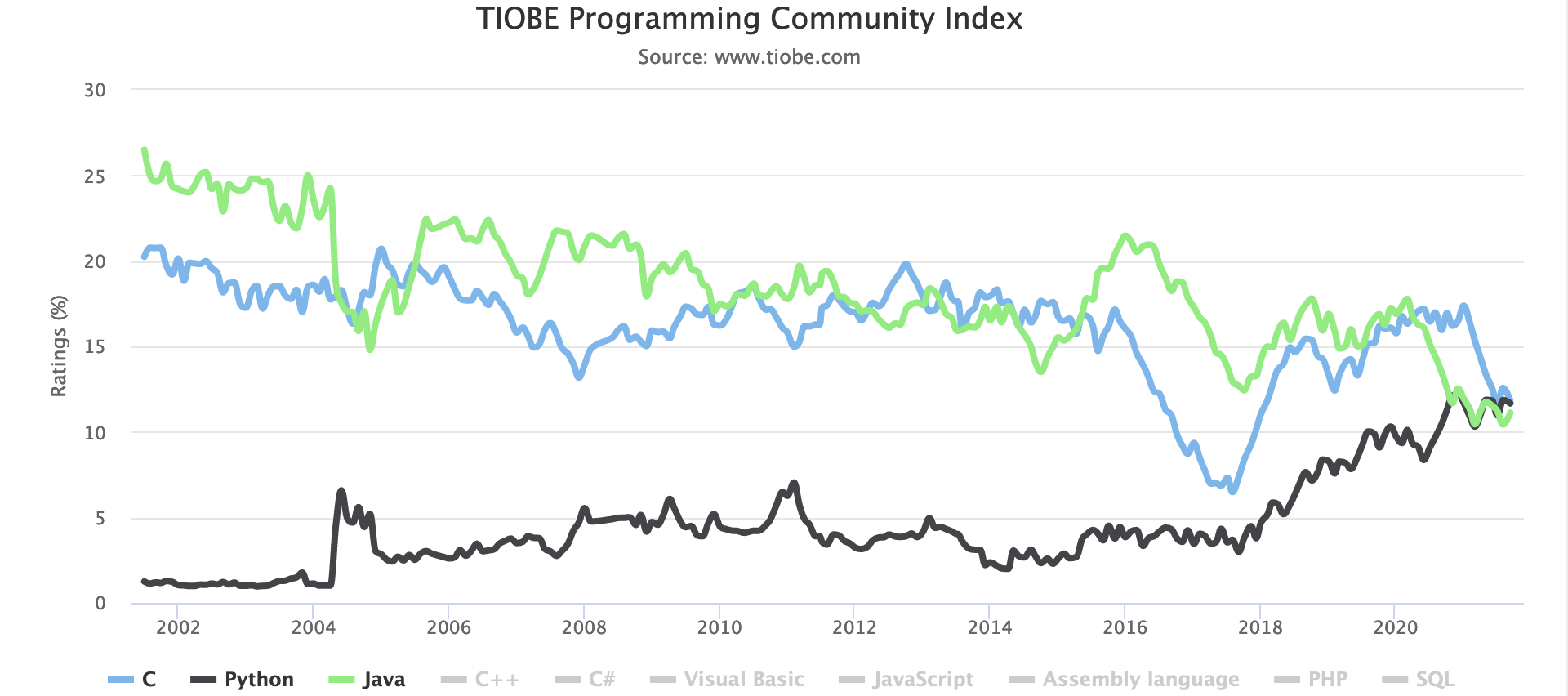
The interesting part of that curve is not that Python rose. It is what it rose against: Java and C++ in general programming, and Matlab, R and SAS in scientific computing. Python did not win a language argument. It won because NumPy, then scikit-learn, then PyTorch and TensorFlow all chose it as their front end, and the data eventually followed the tools.
4. Some pros
Non-exhaustive reasons for its popularity:
-
The syntax. Simple, close to pseudo-code, mostly English words. Indentation is the block structure, so badly formatted Python does not compile, which turns out to be a feature when you read other people’s code.
-
Free and open-source, under a permissive licence, on every platform.
-
Extensive libraries. The standard library plus the Python Package Index (PyPI, well over 600 000 packages) means most of what you need already exists: NumPy and SciPy for numerics, pandas and Polars for tables, scikit-learn for machine learning, PyTorch for deep learning, matplotlib and Plotly for graphics, statsmodels and lifelines for the statistics an actuary actually wants.
-
Multi-purpose. Scientific computing, web back ends, automation, software engineering, all in one language. This matters more than it sounds: a model that stays in a notebook is not a model anybody uses, and Python takes you from the notebook to the API without switching languages.
-
Object-oriented (and quite happily functional too), so projects can be structured and maintained rather than accumulated.
-
Interpreted, which means an interactive prompt, immediate feedback, and the ability to poke at a live object to find out what it does. This is the single biggest reason exploratory data analysis feels good in Python.
-
Dynamically typed, so prototypes come together fast. Type hints were added later for the code you keep, and tools like
mypycheck them without ever slowing the interpreter down. -
Companies use it. Python glues well to the rest of a production stack: databases, message queues, CI, cloud SDKs. The same language survives the trip from research to an end-to-end pipeline. Google, Netflix, Meta and most insurers’ data teams all run on it.
-
Last but not least: the community. Your question has almost certainly been asked already, and answered. Documentation, forums, tutorials and a steady stream of contributors are a genuine technical asset, not a soft one.
5. Some cons
An honest list, because you will meet all of these:
-
It is slow. Interpreted and dynamically typed means pure-Python loops run one to two orders of magnitude slower than C. The standard answer is to not write those loops: push the work into NumPy, pandas or a compiled library, where the inner loop is already C or Fortran. When that is not enough, Numba, Cython, JAX or a Rust extension will get you the rest of the way.
-
It is not memory efficient. Every value is an object with a header, so a Python list of a million integers costs far more than a million machine integers. Again, NumPy arrays and pandas or Polars dataframes exist precisely to store data densely.
-
Concurrency is awkward. The Global Interpreter Lock has long prevented several threads from executing Python bytecode at once, pushing everyone towards multiprocessing. This is finally changing, since CPython 3.13 shipped an experimental free-threaded build and 3.14 made it officially supported, but the ecosystem will take a few more years to catch up.
-
Packaging and environments are a mess. pip, conda, Poetry, uv, virtualenv, wheels, lockfiles: the tooling is powerful and badly signposted, and “it works on my machine” is a Python speciality. This is why installing Python properly gets its own page, and why every serious project pins its dependencies.
-
Some domains are still better served elsewhere. R remains ahead for parts of classical and actuarial statistics, and Matlab for some engineering toolboxes. In practice you use both and connect them;
reticulateandrpy2exist for exactly that.
Most of these drawbacks are addressable by a library, a compiler or a convention, which is precisely why the language keeps winning despite them.
6. What this means in practice
You are going to spend most of your time in a small subset of the language, calling libraries that are not written in Python at all. That is normal, and it is the intended way to use it: Python is the language in which you describe the computation, not usually the one in which the computation runs.
Next step: install a working environment.