Blog Machine learning 2 min read
The bidirectional RNN, animated
Two passes over the same sequence, one in each direction, concatenated. It buys you context from both sides and costs you the ability to run online.
Made in October 2020 for the NLP sessions of the Data Science pour l’Actuaire course at the Institut des Actuaires. Left online because the picture has not aged, even if the frameworks around it have.
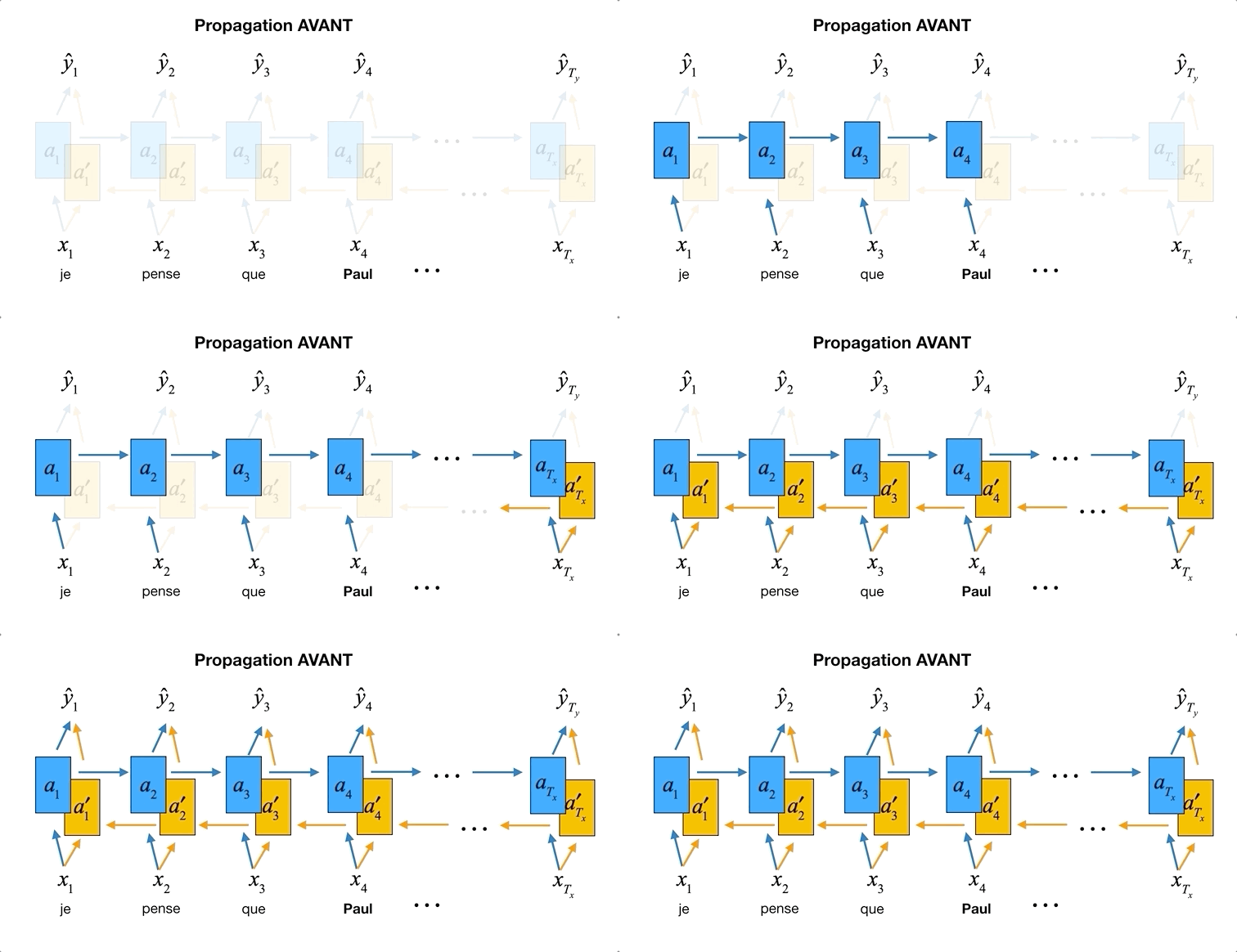
A plain RNN reading left to right knows everything before position \(t\) and nothing after it. For most language tasks that is the wrong constraint: whether bank means a riverside or a branch office is usually settled by a word further along the sentence.
A bidirectional RNN runs two independent recurrent layers over the same input, one left to right and one right to left, then glues their states together at each position:
\[h_t = [\,\overrightarrow{h_t} \; ; \; \overleftarrow{h_t}\,]\]That is the whole construction. The two directions share no weights and never talk to each other during the pass; they only meet in the concatenation, which is then what the output layer sees.
The animation makes the real cost obvious: the backward pass cannot start until the last element has arrived. A bidirectional model therefore needs the complete sequence up front, which rules it out for anything streaming (live transcription, real-time scoring) and is fine for anything where you already hold the whole document. That trade is the same one BERT makes and GPT does not, which is a useful thing to have seen before meeting either.
The original notebook export: BRNN forward. The one-directional version is here.