Projects Research collaboration 2022 to 2024
Predicting blacklegged tick populations
A Lancet review of how the research community predicts where Lyme disease vectors live and how many there are, and of the data gaps that keep those predictions from being trusted.
Why a tick
Ixodes scapularis, the blacklegged or deer tick, is the animal that carries Lyme disease across most of North America. It takes two to three years to go from larva to nymph to adult, it needs a mouse or a deer at each stage, and it only survives where the temperature and the humidity suit it. Warming winters are moving it steadily north, into places that have never had to think about it.
That makes it a public health forecasting problem rather than a purely ecological one. If you can predict where the ticks will be, you can warn people before the cases arrive rather than after. Whether anyone can predict it well is the question this work set out to answer.
The review was published in April 2024 in The Lancet Regional Health – Americas with Bouchra Nasri’s group at Université de Montréal and colleagues across the Mathematics for Public Health network.
What we did
We read the literature, properly. We screened 4661 papers published between January 2012 and July 2022 and kept the 41 that actually build a predictive model of tick abundance or distribution in North America. For each one we recorded what it predicts, how, and on what data.
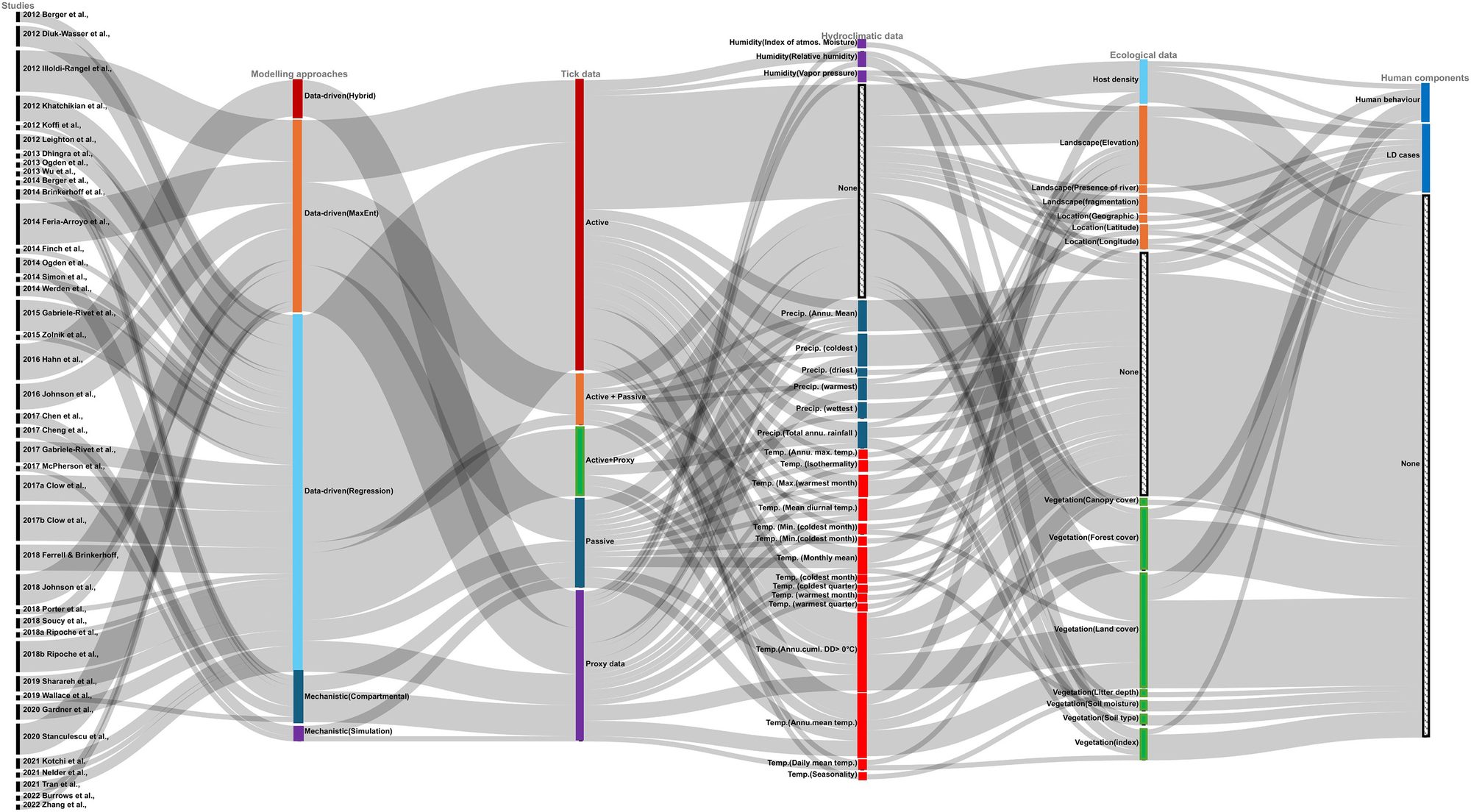
Figure 2 from the paper: every study, the approach it used, and every category of data that fed it. The two widest bands on the right are both labelled “None”, which is the finding in one picture.
What we found
-
Two schools, unevenly sized. Four out of five studies (33 of 41) are data-driven: fit a regression or a machine-learning model to observations and let the data speak. The rest (8) are mechanistic: write down the tick’s life cycle as equations and simulate it. Both work; they fail differently. Data-driven models fail when the data is thin, which is exactly at the invasion front you most want to watch. Mechanistic models fail when your assumptions about the animal are wrong, and they are much harder to read.
-
Predicting “where” and predicting “how many” are different jobs. Just over half the studies (22) predict distribution: is the tick present here, is this habitat suitable. A third (14) predict abundance: how many. Only five do both. That matters, because habitat suitability tells you a place is plausible, not that it is dangerous; risk tracks the number of infected ticks.
-
Almost nobody counts the deer. Every study used tick data. Most combined climate variables with ecological ones. But only 9 studies out of 41 included host density, even though the tick cannot complete its life cycle without mice and deer. This was the finding that surprised us most, and it is the clearest open gap: models are predicting an animal while ignoring what it feeds on.
-
The data underneath is the real bottleneck. Active surveillance, with researchers dragging a cloth through undergrowth, is precise and expensive, and covers short windows that miss a multi-year life cycle. Passive surveillance and citizen science, people mailing in the tick they pulled off the dog, scale beautifully and are biased in obvious ways: they undercount nymphs, which are small, hard to spot, and the stage that infects most people. Roughly a third of studies reported no accuracy measure at all, and the ones that did are barely comparable to each other.
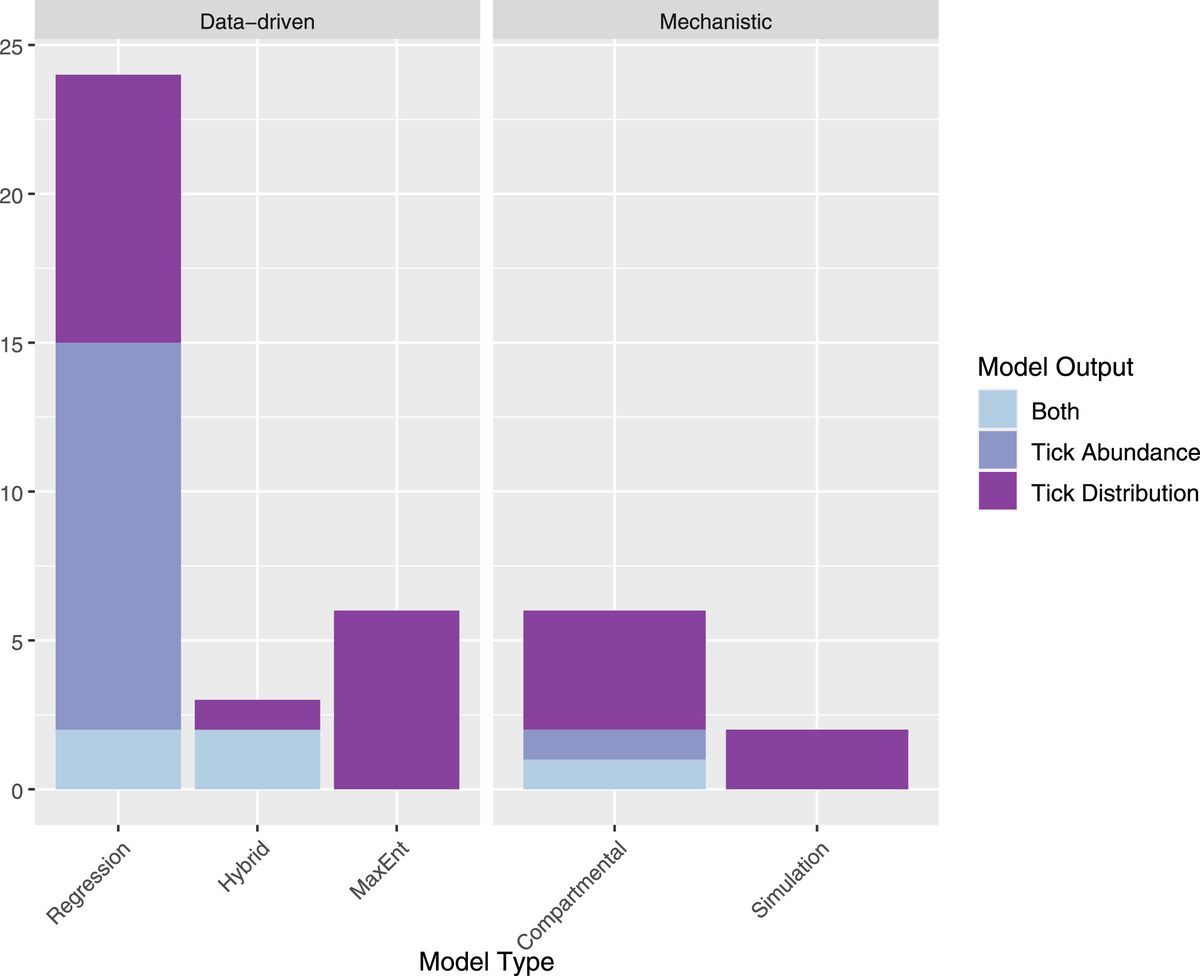
Figure 5 from the paper, which is points 1 and 2 in one chart. Regression dominates the data-driven side, MaxEnt only ever produces distributions, and the “Both” slice is thin in every column.
What we concluded
The modelling has got better; the data has not kept up. The recommendation is unglamorous and, I think, correct: standardise collection protocols, combine active and passive surveillance instead of choosing, publish validation results in comparable form, and put hosts and human behaviour into the models rather than treating the tick as if it lived alone. That is the One Health framing, and for anything meant to warn a public health body it is not optional. A prediction nobody can validate is not a warning.
Reference
Sharma Y, Laison EKE, Philippsen T, Ma J, Kong J, Ghaemi S, Liu J, Hu F, Nasri B. Models and data used to predict the abundance and distribution of Ixodes scapularis (blacklegged tick) in North America: a scoping review. The Lancet Regional Health – Americas, 32:100706, April 2024. doi:10.1016/j.lana.2024.100706 · open access.
Figures 2 and 5 are reproduced from that paper under CC BY-NC 4.0.